ART GUIDELINES
IF YOU CAN DREAM IT, WE CAN PRINT IT!
We will work with whatever you have; from a scribbling on a paper napkin to professional artwork – we have an art department that can make it happen!
Don’t have an in-house design department? No problem. Have artwork but don’t know if it meets all the requirements? Don’t know much about the technical stuff? We understand that not everyone is an expert in artwork or label design – you’re busy being an expert in your field.
THE TECHNICAL STUFF
Ideally, artwork should be submitted in CMYK, Grayscale, or Pantone Spot Colors. We can convert RGB files into CMYK.
For best results, we recommend the following:
- Maximum Colors: 8
- Minimum Font Size: 4pt
- Minimum Reverse Font Size: 6pt
- Minimum Line Size: 0.5pt
- Bleed: 1/16″
- Border minimum: 1/16″
Vector artwork in .ai format is preferred, but .eps, or .pdf work well too. We can also work with Photoshop files for High Resolution (300 DPI) 4 color process or Grayscale images, however if you wish to print spot colors, vector art, or text, Photoshop and raster files can be transferred or recreated in Illustrator.
It really helps if you can send a .pdf for us to compare with the received vector file to ensure that the finished product meets your expectations.
Don’t sweat! We understand that not everyone has access to vector artwork or photoshop files, so we always work with whatever you can provide.
Tips for Best Results
- Please avoid reversing text out of CMYK or other multiple color builds.
- Fonts should be outlined/embedded or the fonts should be sent along with the file.
- Vector is always preferred unless you would like a photograph on your label.
- If your artwork has linked files, please be sure to embed them.
- Text and images should be 1/16″ away from the edge of the label (borders are the exception).
- On CMYK artwork, text prints crisper and cleaner if it’s 100% Black or another solid color.
- Make sure to check closely for spelling and typing mistakes.
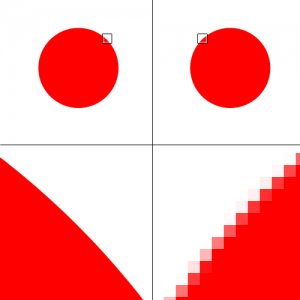
Vector vs. Raster – What difference does it make?
With vector artwork, the art can be resized without losing image quality and resolution, and results in a much sharper image. Raster images are useful for printing photographs, but other than that, vector is always preferred. If you are unable to obtain vector artwork, we can usually use the raster to create a vector version.